Making it different
I’ve said a few times how I’m taking a different approach to training for the Baltimore Marathon, but until today that didn’t mean much. With additional cross training in the past six months, that’s one aspect of being different, but shouldn’t I have been doing that all along?
At work, a group of four of us are committing to doing core work Tuesdays and Thursdays. Just this week we had a session with a personal trainer to teach us a few moves. Those two days are a big commitment to make compared to what I’ve done in any other training session. If we can stick together and be consistent with this, the benefits to my running are things that I can’t wait to see.
My philosophy behind the “non-plan plan” will continue, as I already wrote about, but I’m putting more work into it this year. I’ve stared blankly a lot at a spreadsheet I’ve made to get me through the next four months, but I’m excited about plugging numbers into it.
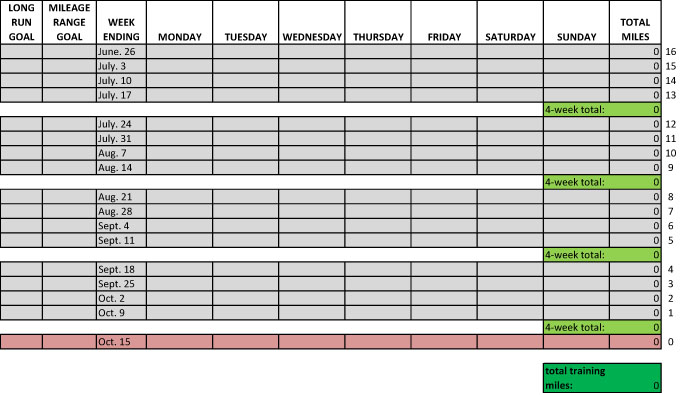
Very soon the next 4 weeks will be plotted out with my long run and a small range of miles I want to hit those weeks. Toward the end of that 4-week cycle, I’ll map out the next 4 weeks. It’s also worth noting that I’m counting race week as Week 0 – to me race week is not training week. It’s performance week. There’s nothing left to train for that week.
Last year I credited using Daily Mile with helping me keep track of things. While I’ll continue to log my miles there, this spreadsheet will help me in seeing what is really happening week to week and, I think, give me a better sense of what I need to do long-range rather than just focus on the week at hand. (If you’re interested in this spreadsheet, send me a message via my Contact page. The formatting is already in place.)
I’ve also made a change to my Garmin by activating the auto-lap function. To be honest, I’ve never been a big fan of the auto lap – I think I denounced it on Twitter as micromanaging runs just a few weeks ago – but as I’ve done a few progressive runs lately, I want to test it for a few weeks to analyze my runs more. Last year I got very content with running just to run at one pace and didn’t analyze things too much.
As I mentioned earlier this week, I want to post more maps of my runs with the elevation profiles and I think using the auto lap function will help when I need to look at a run that went well or bad.
In simpler terms, I want training for the Baltimore Marathon to be more visual. When things are going well, I want to know why, just as much as I want to know why things are going bad. I think making these changes will only enhance the next several months and beyond no matter what happens.




 RSS
RSS Facebook
 Twitter | Web site by Matt Busse

thanks for sharing, especially the spreadsheet. I think this spreadsheet (or @ least writing your numbersdown) can make you be moreaccountable. Good luck.
I'm a very visual person so I can definitely understand wanting to make the feedback from your training more tangible. I'll be interested to hear how this works for you. Good luck!
I use a multi-plan plan. I have a spreadsheet with the scheduled mileage for three different plans. I add my actual mileage beneath the comparisons.
This worked well for me last year. I often have conflicts on long-run days — shorter races or just plans that don't allow enough time for me run for 3+ hours. It's nice to float from plan to plan and fit those 20-milers when it works best for me, knowing I still got enough mileage in for a successful marathon.