My internal shoe debate
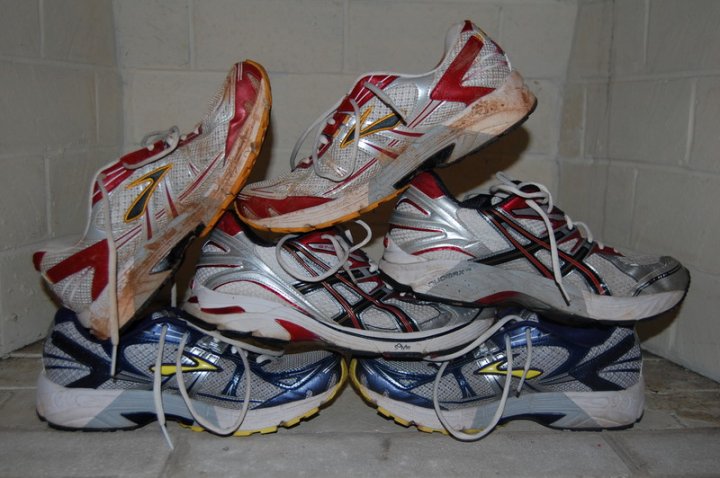
In the mid-1990s when I ran some track in high school and then from 2004 to mid-2006, I didn’t worry about what shoes I wore. I would try on a few pairs and buy what was the most comfortable and economical. Then I joined a training group in the summer of 2006 and got what I thought was an education on shoes.
Don’t get me wrong — I learned a lot about shoes and myself that summer, but it’s also easy to trace my steps back to that moment and see a pattern. My first injury happened at the end of a training cycle that summer. Could it have been my increased mileage over time? Maybe, but in hindsight I know that the mileage buildup wasn’t drastic. Could it have been the change in shoes? Possibly, but it wasn’t like the injury happened right away in those shoes.
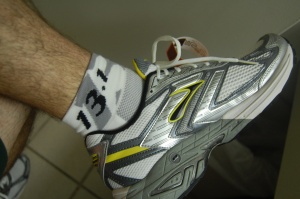
This is one of my Brooks Adrenaline from a couple of years ago.
Fast forward a few years after battling plantar faciitis, going through different shoes — mainly the Asics 2100 series line and Brooks Adrenaline, both stability shoes — and I got a different answer at a race expo at the end of summer 2009 (I first wrote about these shoes here).
Simply put, the shoes I had been wearing may have been too much for my feet. The Brooks Ravenna was still a stability shoe, but just barely. I then strung together my longest injury-free streak since I first got fitted for shoes.
The story of my most recent injury isn’t one I need to rehash, but as I slowly build a base and prepare for marathon training again, I’m analyzing everything. I attribute most of my recent trouble to sloppy running — poor form, not doing enough cross training, etc. Perhaps those are things I’ve always done that led to previous problems. But as I string together a solid couple of months or so, I can’t help but still wonder — do I need to do something about my shoes?
I’ve been thinking about this for a while, but haven’t been able to find the right words until this week. I’ve been rotating two pairs of shoes of the same model for a year and a half — it definitely helps increase my mileage, I think. I recently started to wonder if I should rotate two models of shoes though. I see so many of my Daily Mile friends doing it, but no one really explained why.
Then, this week, I read this post from Fitz over on Strength Running who discusses this very topic. In a response to my comment, Fitz credits Pete at Runblogger for discussing this subject as well. (Both blogs are great, by the way, so add them to your blogroll/reader. You’ll learn a lot from them.) In reading Fitz’s post I realized what my “problem” may be — I’ve learned this certain way to think about shoes and gotten in my head what I “need.” Yes, I do need good shoes, but do I need just one model?
Despite working on my form, always running on hills by default and mixing up the types of runs I do, the fact remains that running is a repetitive motion. Eventually my body is going to get used to all that and, very likely, have some sort of injury. That’s not negative thinking — it’s the truth.
But looking at my friends on Daily Mile who rotate different types of shoes, there’s a pattern — they remain free of major injuries.
All this brings me to present day and what I did yesterday — for the first time in 5 years, I tried on a shoe that didn’t have “stability” labeled in front of it. I was in a chain store, so I didn’t feel guilty about just trying on a pair, and didn’t have a salesman try to talk to me about why or why not I “needed” a certain shoe.
I tried on a pair of Brooks Ghost 3, a “neutral” shoe. I’ve heard a lot of good things about this shoe and my trying-on test didn’t disappoint. They were very comfortable. I also tried on one shoe while wearing a retired running shoe to see if I could feel the difference. There wasn’t much.
As with any shoe, though, the true test doesn’t come until there are several runs in them, which is unfortunately impossible with any shoe.
Last night I posted on Twitter and Daily Mile a question about making the switch from stability to neutral and I got no reasons not to do it. In fact, several people have made the switch with no issues.
So why am I writing all this? I’ve already answered that — I’ve learned a certain thing about shoes that I can’t get out of my head. For a while with my Ravennas I’ve had the “if it ain’t broke” mentality, but an injury proves that something — perhaps several things — is broke. I’ve worked on everything else without even thinking about my shoes, which is a mistake. I’m not going to get rid of my Ravennas, but perhaps it is time to mix it up.
If you’ve ever switched types of shoes, or have any advice on this subject, I’d love to hear it.



 RSS
RSS Facebook
 Twitter | Web site by Matt Busse

I switched from stability to neutral as I lost more weight. It just didn't seem like I needed stability anymore. That and I went to three different running shops and had my gait analyzed and got the same answer each time. But I'm starting to wonder the same thing now that I'm injured, do I change my shoes? I've been rotating between 2-3 pairs for a while now, but now I can't run at all. I'm interested to see which shoes you end up with!
Do you also wear custom-made orthotics? A neutral shoe with orthotics is a great combination! You get stability tailored to your foot — so just the right type of form. And then you can get the new shoes you were eying.
I try to run 3-4 times per week on at least 3 different surfaces (trail, treadmill, and asphalt). I wear trail shoes on trail day, so that creates an automatic shoe rotation. I have been running regularly for 2 years and have run with the occasional discomforts, some that even required a slight limp, but nothing that I would describe as a major injury. Basically, I try to put as much variety into the weekly routine as possible including ample barefoot time (indoors on the elliptical). Asphalt and treadmill shoes are Asics GT2160. Trail shoes are Asics Kahana 4.
Thanks for the shout out Dave! I think it really helps; give it a whirl
Very interesting post. I currently have the 'if it ain't broke' mentality too. Thing is, my running has changed ssoo much. I've switched from heel striker to mid-front foot and even lost some weight. But I'm afraid to switch from what's worked well. Maybe I'll do what you've done and go get a pair of retail store shoes for the days before work and see how it goes. Thanks for the info. Good stuff.
After upping my running miles about 16 months ago, I found myself more and more intrigued by the minimalist shoe concept. I spent a fair bit of time on runblogger's excellent site, read some other stuff too. Basically the concept of training the body to run right makes more sense to me than doing it wrong and relying on shoes to make it ok. So last fall I went to Famous Footwear and bought a pair of flimsy $20 Gola shoes. (It seems most minimalist shoes are far from minimally priced! But these met all of runblogger's min shoe criteria.) So I sprung for some VFFs this spring. I now run about equally in the Golas, the VFFs, and a pair of traditional NBs with about 700 miles on them. Not for everyone but the rotation has worked great for me.
I encourage you to try different shoes. At a minimum, you'll learn *why* you need whatever shoes you end up in. That knowledge, and the confidence that goes with it, is worth the price. Happy running and thanks for the post! (And @bikerly for the link.)
When you were injured, did you bring your shoes to the doctor and ask if they're what you "should" be using? I did that, brought my shoes to both doctors I saw, both doctors said it wasn't the shoe, it was just plain over-use. I know, different people, different injury.
But Kali's comment is interesting, she lost weight & switched to the neutral shoe, that's something to consider since you've lost weight.
I thought this video was interesting on going to a minimal shoe: http://host.madison.com/wsj/sports/video/vmix_999…
But this is also the guy who sold me CW-X tights before my 2nd marathon & told me to go for it.
I'm of the "if it ain't broke" mentality too. Today I just reordered my exact same shoe. I've been in the Mizune Wave Inspire through several models now, and have had the best injury-free streak (or at least no injuries due to running). Every once in a while I've tried a different shoe but returned them after a run or two (my running sore permits returns within a short time period). That said, I only run 3 days per week and I wear different shoes for cross-training (elliptical). Everyone is different and I think some people are more sensitive to the "right" shoe than others. Can't wait to hear how this works out for you.
Thanks for all the feedback on this — this is a great discussion. I still haven't made any decisions. When it comes to shoes, I go back and forth in my head a hundred times before buying something. Plus I'd like to continue to do more research on the subject.
Well written thoughts. I have worked my way into running in multiple shoes. Different shoes for different runs. I run almost exclusively in non-stability shoes for shorter runs, but still hold on to the stability shoes for the longer runs because if I go anything over 7 or 8 miles in neutral shoes my right ankle (the side I pronate) starts screaming at me.
Good luck with working this out, I will be interested to read what you find out.
That's good to know Tim. I did buy a pair of Ghost 3 this week. I'll blog about all this again after a few runs in them.