Posts in Category: Q&A/Guest Posts
Bring on Disney
I’m taking part in the Disney Marathon in a little more than a week … that seems a little weird to say. After battling the flu last month, continuing to fight an annoying cough and just now getting back to feeling normal on a run, my main goal will be to have fun. I might just leave the watch behind so I don’t even know how slow I am.
More important that my performance, though, is why I’m running Disney. As I mentioned a few weeks ago, I’m joining Comfort Zone Camp’s Grief Relief Team.
Comfort Zone Camp provides free grief resources and resilience training to children who have suffered the death of a parent, sibling or primary caregiver. Their programs focus on the strengths of each child, empowering them to grieve, heal and grow in healthy ways.
Comfort Zone Camp CEO Lloyd Osgood is hoping to raise $20,000 for the Grief Relief Team by running the Goofy Challenge next week. Recently she answered a few questions about Comfort Zone Camp and why this is such a special event and cause.
 What makes Comfort Zone Camp and Grief Relief Team special? What, for example, does a $50 donation do for a child?
Comfort Zone Camp understands the isolation a child feels following the loss of a mother, father, sister or brother. Our free weekend programs offer grief resources and resilience training so that our campers feel the support of a compassionate community, learn they are not alone and leave with valuable coping skills for daily life. Comfort Zone Camp is special because our staff and volunteers make it so.
The Grief Relief Team is the only one of its kind in the nation that we know of. While our runners participate for many reasons, the one thing that unites them to our cause is their desire to make a positive difference for a child or teen suffering the loss of a parent or sibling, undeniably one of the most traumatic events a child can experience.
Many Grief Relief Team members are actually Comfort Zone camper families, running to honor the memory of a loved one and to give back to a program that brought them comfort during a difficult time. A number of our volunteers run on the Grief Relief Team as well, taking their commitment to our program to a whole different level.
A $50 donation underwrites the cost of sending a child to camp. That $50 could go toward our volunteer recruitment and six-hour training process. Or we could apply it toward our extensive screening process where skilled professionals conduct interviews with those directly involved with the well-being of the child, for example, the parent, guidance counselor, and psychologist.
Another option would be to put the $50 toward the 1:1 matching process where campers are matched with a volunteer mentor whose sole purpose is to set each child up for success as he or she joins the Comfort Zone Camp community and learns to manage grief in a healthy way. Or we could use it to buy all the supplies we need to make s’mores at our bonfires!
Tell us why you chose to run the Goofy Challenge? What makes Disney such a big event?
To be perfectly honest, it was the bling. That’s what motivated me to sign up last spring right before the event sold out. If you run the Goofy Challenge (13.1 miles on Saturday and 26.2 miles on Sunday), you leave with a medal of Donald Duck for the half-marathon, a nice Mickey Mouse medal for the marathon and a big brass Goofy medal for doing both.
Three medals, two races, one great cause.
When you’re out there training, what goes through your mind as you know you’re running for a cause beyond your health?
I have logged some miles training for this race … lots of miles! It feels good to know I am part of a network of people who care about what happens to children suffering the loss of a parent or sibling and are willing to support my run financially to help a child in grief. Knowing I am raising money to make a difference for grieving children will keep me running — one foot in front of the other — for all 39.3 miles until I’ve crossed the finish line. Twice.
How many races have you done, and which is your favorite?
I ran the Monument Avenue 10k in Richmond once. In 2011, I ran the Disney Half Marathon and now I’m running the Goofy Challenge. Not a big racer. I like to run in the dark in the early morning with a group of friends, where I can run my run and not have to worry about thousands of other people in my path. Unless, of course, major bling and a good cause are involved.
What are your big goals for Comfort Zone Camp heading into 2013?
We have a solid program year planned. Each of our four locations will hold a combined total of 22 camps including our traditional weekend program, several one day programs, and a weekend program for young adults. In addition, we will hold five camps in concert with various partners around the country. The big goal for 2013 is to continue to strengthen our organization — from programs to volunteers to fundraising and infrastructure.
It’s like running a marathon; we have to invest in the systems and processes we need in order to build to last.
To donate to the Grief Relief Team, visit Lloyd’s fundraising page.
Since the program originated in Richmond, Va., Comfort Zone has grown to serve more than 9,000 children at year-round camps in Virginia, California, New Jersey and Massachusetts. Each camp hosts approximately 60 campers, four Comfort Zone employees and up to 80 trained and screened volunteers. Key program components include traditional camp activities, confidence-building exercises and age-based group counseling led by trained and professional grief therapists. All campers are paired 1:1 with their own individual volunteer mentor (Big Buddy) whose sole purpose is to set each child up for success as they join the Comfort Zone Camp community and learn to manage their grief in a healthy way.
Running because SHE can
I won’t give you a long drawn out intro to this post — I asked my wife Christina to write about her Runner’s World Festival experience where she ran her first 5k. Without delay, here you go:
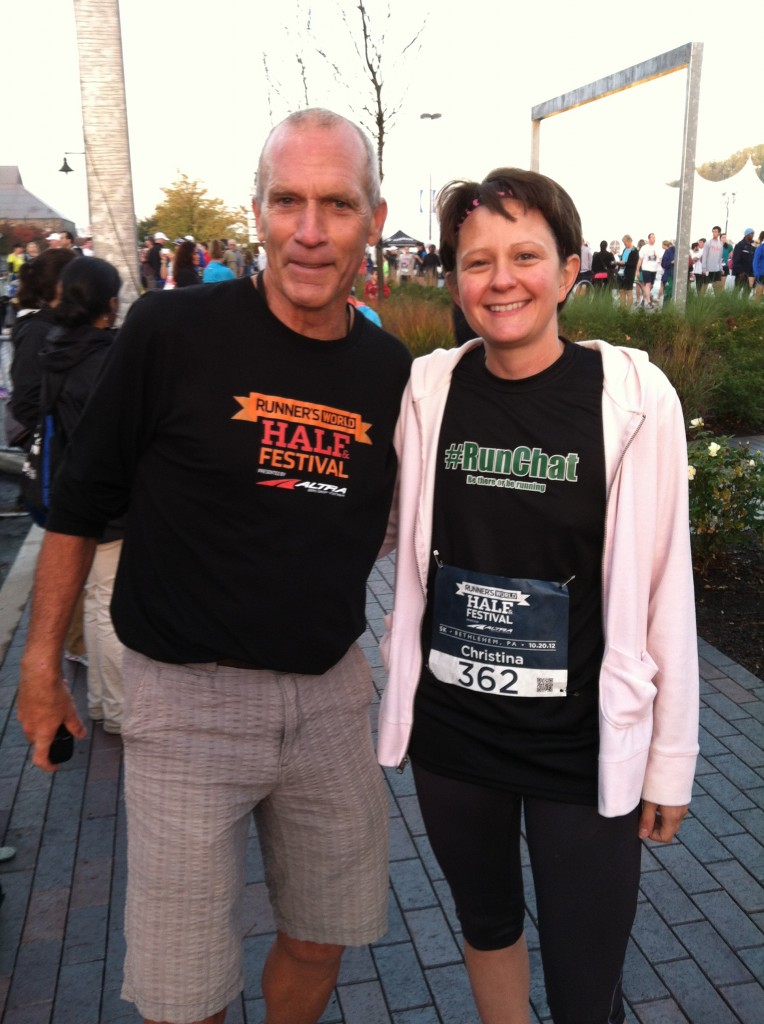
Christina and Bart Yasso before the 5k
For eight years I have stood on the sidelines, cheering on my husband David in more races than I can count. I have gotten up before the sun and dressed in layers.
I have held signs, swung clappers and rung cow bells. I have seen the sheer exhaustion, and triumph, in every runner’s face.
I have watched anxiously for David’s face to appear among the crowd, and at one marathon even backtracked from the finish to see how I could help him after I got a text that he was going to start walking.
This year, after eight years of being a spectator, I decided to take on the challenge of a 5k.
I’ve always hated running. Gym was always my least favorite class in school. Exercise was never discussed in our household growing up.
It’s not that as kids my brothers and I weren’t active, we just didn’t make it a point to “exercise.” I’ve never had a problem with my weight, either, so physical activity never appealed to me.
David brought some exercise into my life. I joined him when he lifted weights (thinking I could tone my arms in time to wear a strapless gown at our wedding), and we did a lot of walking in our neighborhood and hiking in the mountains.
I actually ran a race in 2007, the July 4th Academy Mile in Lynchburg, Va., but since I felt like I was going to die at the end I don’t really think it counts.
Our son waiting for mommy!
I still really didn’t start running until David signed me up (with my permission) for the Runner’s World 5k on Oct. 20.
I recorded my first run on July 24 and at the time was only using a stop watch.
Once I switched to using MapMyRun on my iPhone in mid-August and could see how far I was running, I was much more motivated and enjoyed trying to beat my previous runs.
Yes, I said “enjoyed.” It didn’t take long to actually look forward to going out at 7 a.m. for a run, whether it was to prepare for the 5k or just to have time to myself to get the day started.
The week before my race was the first time I did 3 miles. I ran/walked 3.02 miles in 36:11, and I was very pleased.
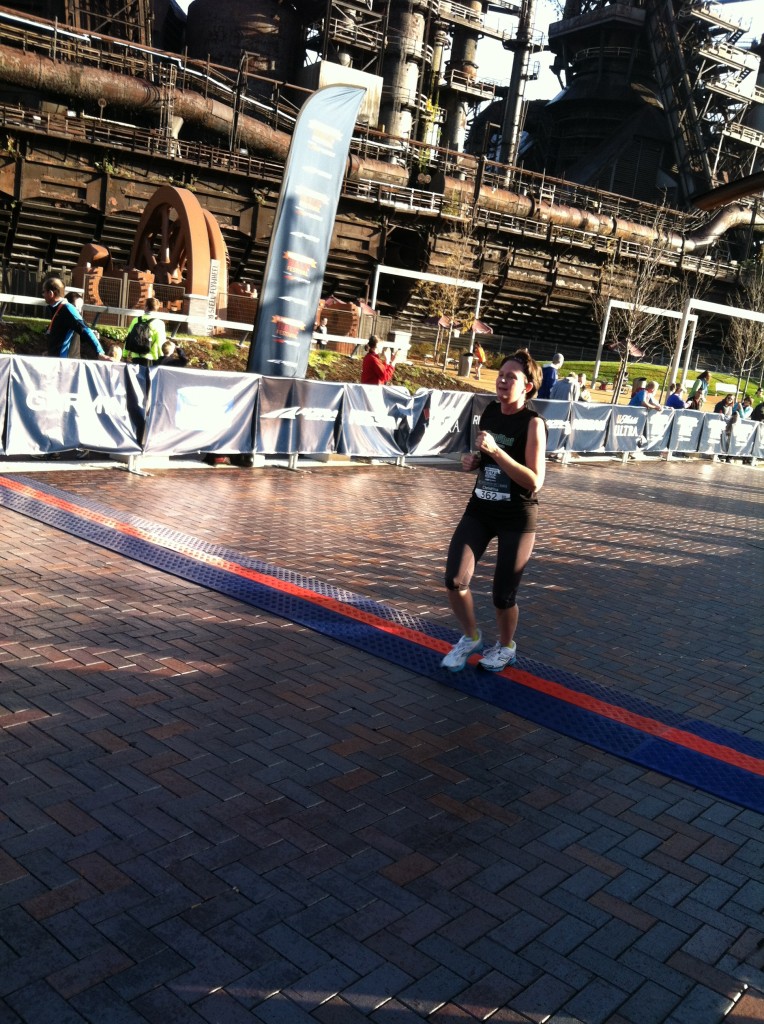
Nearing the 5k finish
I figured that with the momentum of the crowd at the race, I would have no problem with a 12-minute-mile pace.
Unfortunately, that wasn’t the case. I didn’t wear a watch or take my iPhone, so I had no idea how I was doing.
Plus, I found out after the race that the clock at mile 2 was off by quite a bit, so I was under the illusion that I was running a decent pace.
I finished in 40:01. Although I was disappointed, I keep reminding myself that I DID finish, and actually came in ahead of about 100 people.
I know I could have pushed myself more, but, as my chiropractor pointed out, I now have a PR – one that I have already decided I am going to beat.
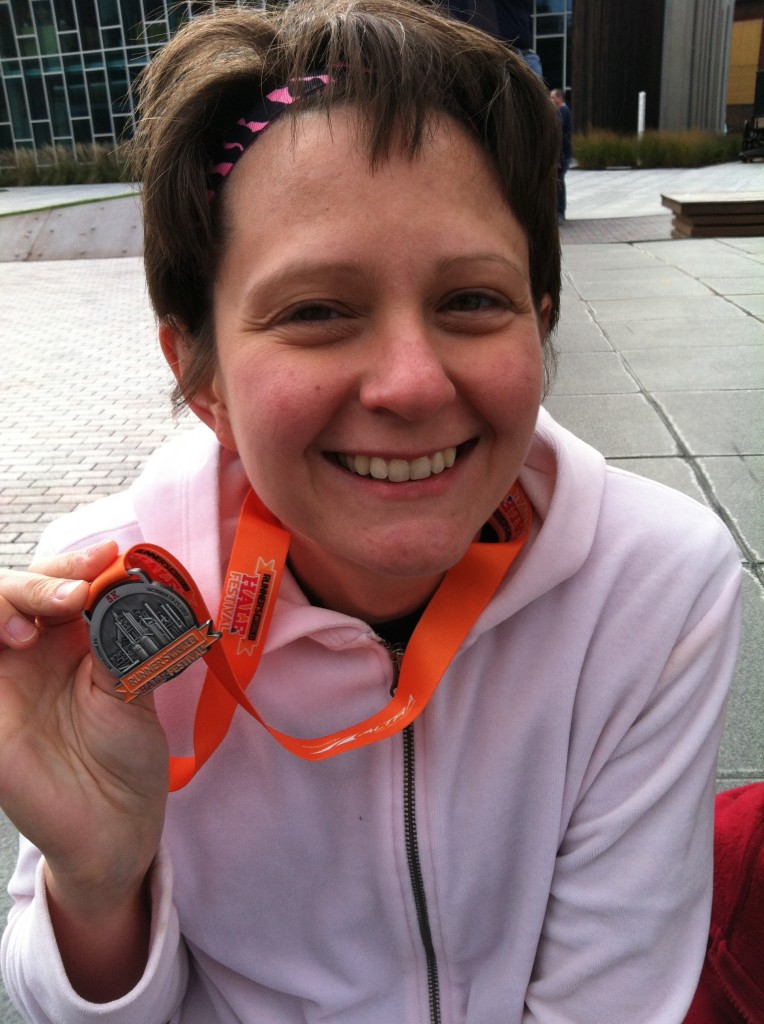
After the race, our son said, "You still got a medal." And what could be better than that?
Q&A with Marathon Brian
I’ve been a part of Daily Mile for two years now and feel like I have gained a lot of true friends, many of whom I have yet to meet in person. One of those people is Brian, who is far and away one of the top commenters on my workouts. I look forward to hearing from him after most of my runs.
He has a weight loss journey that I greatly admire — he lost 70 pounds in 2010 and blasted through an awesome race year in 2011. He also launched a blog somewhat recently — Marathon Brian. If plans fall into place, I’ll meet Brian in person later this year at the Richmond Marathon.
It is my pleasure to welcome Brian to my blog today with a Q&A. I hope you enjoy!
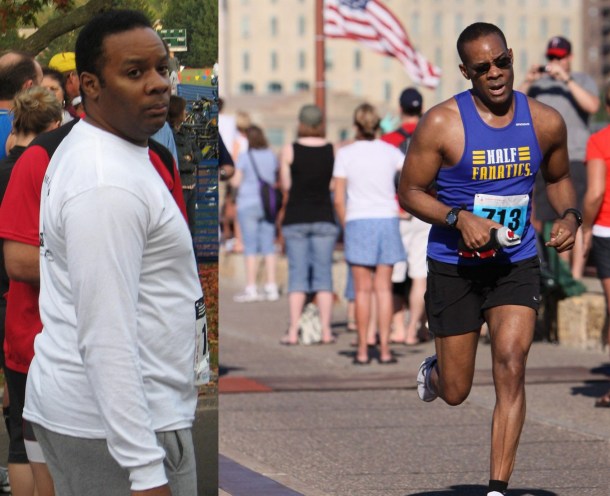
A before and after of Marathon Brian
What was your first race? Describe your thoughts?
My first race was AIDS Run Walk Chicago on September 15, 2007. I was 40 years old at that time and participating in employee/client events like this were “part of the job” of being a senior executive in a company.
I had been a consistent recreational runner for 11 years, but never pulled the trigger on participating in an actual race. I was confident that I wouldn’t embarrass myself pre-event, and placed 9th in my Age Group and the top-29th percentile in a fast track 5k event.
I emerged from my first race with the “vision” that I could actually win Age Groups and an overall event if I focused, trained consistently, and put my heart into it.
I’ve finished second in my Age Group at the AIDS event for the past 2 years and finally won an event Age Group title in 2011, but the vision and groundwork was established in my first race.
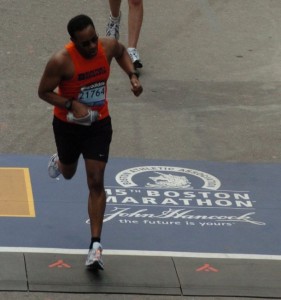
Brian crossing the Boston Marathon finish line
You are scaling back your marathon schedule this year a bit. What are you looking forward to most?
I participated in 16 events in 2010, the first full year of my “return to fitness,” but many of those events replaced regularly-scheduled training runs and workouts, setting 14 new Personal Records (PRs) that year. I participated in 16 events in 2011, but it was much more difficult to improve upon 2010′s strong results, only setting 9 new event PRs last year.
However, I experienced tremendous growth as an event competitor in 2011 that wasn’t always reflected in placements and timing results. I went from running 0 marathons to 6 in 12 months, including debuting at Boston.
I also became a serious contender in short and middle-distance events, with expectations that I’d be in the running for high overall placements and Age Group hardware.
Unfortunately, I lost the “organic spark” that made training and event participation enjoyable for me in 2010, often doing events because it was on the schedule or that I paid it.
So I made a decision to leave several events off 2012′s schedule, cut down on flying and travel, and allow more legitimate time for growth and experimentation. I’m enjoying my current training and preparation efforts, so I’m hoping that carries over to actual events this season.
Your weight-loss journey and continued fitness is admirable. What keeps you so driven to continue to improve?
I’m motivated by many of the same factors that spurred me on after my first race; you realize that you can improve more after you’ve improved more. I’ve finally achieved my goals to win Age Groups and place higher, but I still haven’t won an overall event title. The dream of an overall win keeps me humble, dedicated, consistent, and motivated.
How has your healthier lifestyle impacted friends and family?
Those close to me have probably gotten used to it now, but I think I flipped a lot of them out in 2010, losing almost 70 pounds by time I crossed the Chicago Marathon’s finish line. I was also in training all the time, on a diet all the time, and that’s a jolt for some friends who were accustomed to my well-stocked “snack food cabinet” in the kitchen and a refrigerator loaded with soda and beer in past years.
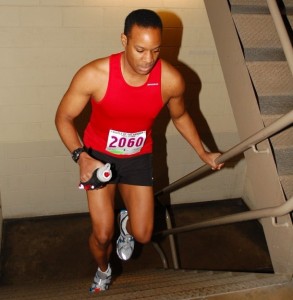
Brian in the Hustle Up The Hancock in Chicago, a 94-story stair climbing event.
There’s still the friend who says “you’re too skinny,” every once in awhile, but most people are happy that I’ve found something that works for me.
I now store organic specialty tea in the former snack food cabinet and haven’t had beer or soda in my refrigerator since last summer. I don’t miss them.
What’s one piece of advice you have for someone seeking to make a lifestyle change?
Writer Malcolm Gladwell in his book, “The Tipping Point,” describes how human behavior is influenced by one’s environment. By early 2010, I was heavily involved on Twitter, Facebook, and Daily Mile; most of my “friends” being athletic individuals participating in events and meetups; actively celebrating their joy and accomplishments.
One of those “friends” called me out in January 2010, because I wasn’t adding much to our online friendship with my lack of consistent commitment to training and event preparation. I was ready to make a permanent change, but that particular individual’s message was my “tipping point” to move forward and achieve the goals and dreams first crystallized in 2007.
The tipping point is different for everyone. It may be staying healthy for your family, staving off obesity or diabetes, squeezing into those “skinny jeans” you’ve been saving since high school, or to win a race, but someone desiring to change their lives has to tap into what pushes them towards success.
What’s one non-running thing many people don’t know about you?
A few of my online friends and followers may have picked up on this, but I’ve become a bit of a “Nutrition Czar,” railing against the insanity of consuming processed food, junk food, soda pop, etc.
At the end of 2009, I needed snack chips, ice cream, frozen pizza, soda, and greasy food to get through stressful days. It took time, but I slowly “kicked” my need for those food items out of my daily life replacing them with healthier, more nutrient-rich food choices, such as oatmeal instead of packaged breakfast cereal, brown rice instead of white flour pasta, apples and bananas instead of ice cream, and water or tea instead of soda.
It’s amazing how you feel when your regularly active with physical activities you love, fueled by healthy food choices. I can’t imagine returning to the largely inactive, junk-fueled life I led before 2010, and that’s pretty exciting.
You can find Brian on Daily Mile, Twitter, and his blog. You can find previous Q&As with other bloggers here.
Q&A with Train to Tri
Earlier this year, a former co-worker of mine created a blog — Train to Tri. Jeremy — who now lives in Richmond, Va. — and I worked together for about a year in 2002 in Lynchburg, and even collaborated on a top design award for our newspaper in the Virginia Press Association Awards that year.
That was well before our running days. And even though I lived in Richmond for a couple of years, we ran together only once (I actually wrote about that run here). That is unfortunate because Jeremy has turned into a training beast, and I highly admire what he has done in recent years and this year as he tackled triathlons.
Today I devote my blog to Jeremy with a Q&A. After you’re done here, go add his blog to your Google Reader or RSS feed or however you read blogs.
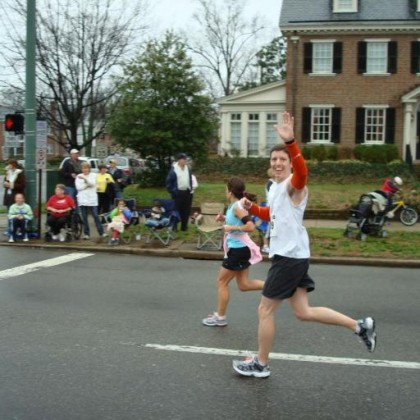 Q: You collapsed in your first marathon and were told to not try another one. What made you defy the doctors and come back?
First of all, thanks so much for the opportunity to chat on your blog! I’ve been following for many years and it was in the front of my mind when I started my own training blog in January.
In the days after I collapsed at Mile 24 of the marathon in 2006, there was a fear that it was caused by an underlying heart condition. My family has a history of heart issues, including a cousin who takes medication every day for the same condition that makes high school kids drop dead in the middle of football practice. I spent three days undergoing tests in the hospital’s cardiac unit, and then follow-up tests in the months afterward. None of the tests showed any reason for concern, thankfully, and it was determined that my collapse was a result of environmental conditions on race day. (The race was in mid-November but there was a sudden heat wave that pushed the temperatures into the 80s. I suffered from heatstroke and severe dehydration.)
In my last visit with the cardiologist, after he informed me that he couldn’t detect any issues, he casually said, “You can still run, but I wouldn’t recommend any more marathons.” I felt like he was just doing his duty, covering his bases, and that there was no real basis for his statement. Every test had shown I was healthy. If any of the tests had indicated a reason for concern, I would have heeded his advice more closely.
As it turns out, I’ve been running ever since that experience, including a marathon the following year (how could I not make it my goal to complete the race that had humbled me?), and I’ve never been worried that it might happen again. Of course, I’m much smarter now about listening to my body and respecting the conditions of the run.
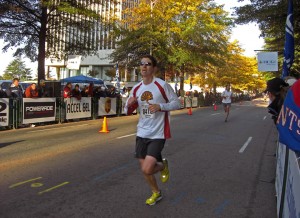 Q: This year you’ve been intensely focused on triathlons and more recently PRing in the Richmond Half Marathon. Where do you think your determination has come from?
I’m a very goal-oriented person, like many runners. However, after six years of running recreationally, my infatuation with the sport was fading. I registered for the same half-marathon each year just to give myself incentive to keep running, but I just wasn’t excited about it. I realized I needed a new challenge to spice up my training, and that’s where triathlons came into the picture.
It was very exciting for me to have two new sports to learn — I was never a swimmer and not much of a cyclist, either. Running became my comfort zone when the other two disciplines would frustrate me, which was often. It was hard for me to have to learn something from scratch, to not be good at it immediately. But I loved the challenge that triathlon presented. I had something to work on every day, and training became a large part of my life.
It’s funny how a taste of success drives you to work that much harder. I had no choice but to get better at swimming and biking — there was nowhere to go but up. But along the way I realized that my running was improving, too. It got to be that I was excited to see what I could do on every training run, and I pushed harder and harder. Eventually I realized I was going to be in a position to destroy my half-marathon PR. I felt like I had a responsibility to work as hard as I could to fulfill my newfound potential.
Last year I was amazed when I PR’d my half-marathon with a time of 1:41. I had no idea I could hold a sub-8 pace for that distance. This year, after almost 11 months of dedicated and intense training, I ran the same distance at a sub-7 pace, finishing in 1:30.
I find that I thrive when I have a tough goal to meet — I enjoy the training when it challenges me. I like seeking my limits, and I’ve learned to rethink what’s possible for myself. Many runners find solace or freedom or clear thinking during a run, which can be great reasons to get out there.
But they’re not my reasons. I’m honestly not sure that I would ever enjoy extended periods of downtime or “easy” running, which is what I had been doing for the past few years. This year has shown me that I’m happiest when I’m trying to push the envelope.
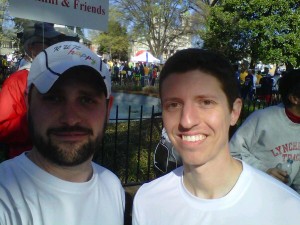
Jeremy and I after the Monument Avenue 10k in Richmond in April.
Q: How have you juggled your evening work schedule and family life? How challenging has that been?
It might seem odd to most people, but working evenings is all I’ve ever known. I worked evenings in college, and I’ve worked evening jobs for newspapers ever since I graduated in 2000. I love it because I have my days free to exercise or take care of the normal family/household duties. It’s also been wonderful because I’ve been able to be at home with my daughter every day since she was born almost four years ago. I would never trade that time I’ve had with her.
My wife and I started dating in college, so this schedule is also all that we’ve ever known as a couple. It’s true that we don’t get to see each other very much during the week, but she has Fridays off and I have Mondays off, so we get long weekends together every week. Whenever my job gets me down and I think about finding a new career, I find myself hesitating because I like my schedule too much to give it up!
Q: What are you thinking about for 2012 or beyond?
Well, I haven’t even announced this on my own blog, but here goes — I plan to make my return to the marathon at Shamrock in March. After the success I’ve had with running this year, I realized I would be cheating myself if I didn’t take advantage of my fitness to make another go at a distance that has dogged me in the past. I’ve only finished one marathon, in 4:07, and both of my marathon training cycles left me with months-long injuries afterward.
But I’m a smarter runner now, and I have a lot more miles on my body. I really think I’m ready to tackle it again. That’s my total focus right now — my training cycle starts Nov. 29 — so I have no idea what else I might attempt in 2012 after that race. Someday I would consider a half-Ironman triathlon and perhaps an ultra-distance running race, but those aren’t specific things on my radar right now.
Q: What’s a non-running thing people may be surprised to know about you?
I drove a tow truck full-time to support myself in college. It was kind of a fun social experiment to see people’s reaction when they found out that the grease-covered kid pulling their car out of a ditch was also an English major at the town’s college (which happens to be somewhat well-regarded).
It was a fun job that even paid pretty well. You never knew what was going to happen at a scene — it could be a simple jump start or it could be a multi-car pileup on the interstate. But now when people find out, they start coming to me when there’s something wrong with their car. I don’t know what’s wrong with your car, but I know how to tow it somewhere.
Q: If you could run like any animal, what would it be?
Hmm, this is a tough one. Cheetahs are fast, but only for short distances. They’re also kind of cliche when comparing running skills. And, besides, I wouldn’t want to run on four legs. So, maybe an ostrich. They can maintain 30mph for 10 miles or more — and they do it on two legs! Even if I hit the wall after the first 10 miles, I’d have quite a lead on the competition.
In addition to his blog, you can find Jeremy on Twitter and on Daily Mile. You can find additional Q&As here.
Q&A with @bikerly
It’s been a while since I’ve done a Q&A, so as I bottle up thoughts in my head, now is a great time for a break from me.
Meet Jim, aka @bikerly on Twitter; you can also find Jim on Daily Mile here. Jim is a blogger over at Loving the Run (where you can find a guest post by me today about my fundraising experiences), who is also currently in the middle of a run streak to raise money to benefit Feed My Starving Children. You can read more about those fundraising efforts at the Race for Others website.
Q: Tell us, where did the idea come from to do a run streak for charity?
I’ve always been fascinated with the idea of running every day for a year or more. This is actually my third run streak. I started with a 30-day goal and my previous best effort was 112 days. This time I hope to make it for 365+ days.
Regarding the charity, I noticed a blog post last year from Kelly (@chmpgnepolitics), focused around “Racing for Others.” I was moved by her blog posts, struggles with fundraising/training and ultimate success in finishing a first time marathon.
I continued to learn more about Feed My Starving Children and discovered they were based in my home state of Minnesota. I was impressed by their vision and that only 7 percent of donations was used for administration costs with the remaining 93 percent going directly to feeding programs for nearly 70 countries. [Note: Feed My Starving Children has a 4-star rating through Charity Navigator.]
Kelly and I chatted about going big with another fundraiser and joined up with Brady and Matt with the goal of raising $10,000 for Feed My Starving Children. It’s a super big number, but $10,000 feeds a village of more than 100 people for a year. And running every day feeds my soul.
Q: What has been the biggest surprise during your run streak?
Almost every day provides surprises … some pleasant, some not so pleasant (like goose poop on a barefoot run).
The other night I discovered a new alley. For three blocks I saw friends drinking bottles around backyard campfires, kids playing tag, late evening dinners through the kitchen window and friends working on a garage project. This route is now one of my favorites.
One thing I’ve learned by running every day is sometimes it pays to take a new course.
Q: Being from Minnesota where it’s very cold for half the year, what is the craziest weather you’ve ever experienced on a run?
A picture often tells the best story…
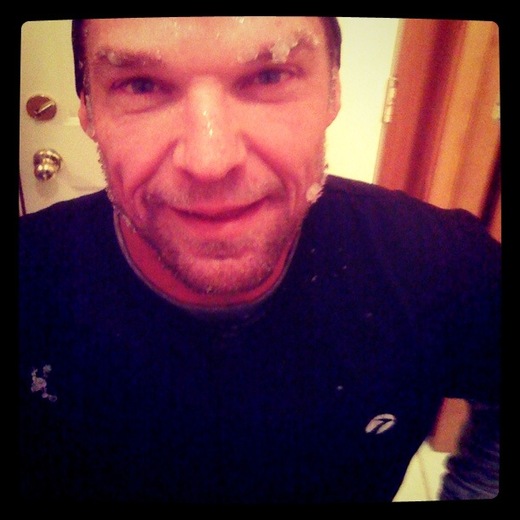
I love running in snow and ice. 
Q: Many of my readers are familiar with #runchat, but you also have a cool Twitter chat in #bikeschool. How did that get started, and what should first-time participants expect?
Well, I hope they like beer and tacos because #bikeschool often rolls this direction. It’s true … Darryl (@lovingthebike), Mike (@egggman), and I conspired last year to host the #bikeschool chat every Thursday night at 9 p.m ET. The format is much the same as #runchat and questions vary from gear related to the philosophical taco related question. The school even has a mascot in @tacomakingrobot! You can read more about the #bikeschool shenanigans on lovingthebike.com if you like.
Q: Lastly, what’s one non-running (or non-biking) thing that people may be surprised to know about you?
I grew up on a livestock farm in Iowa.
Thanks to Jim for a great Q&A. If you’re interested in doing a Q&A or guest post exchange, please hit me up on my Contact page.
From 290 to a marathoner: Meet A Healthy Dad
Brandon on a vacation in mid-2009.
Having gone through a weight-loss journey, I love finding runners who have also lost weight. Sometime in the past year I came across Brandon’s blog, A Healthy Dad. I also follow him on Twitter and stay up to date with his workouts on Daily Mile.
In December 2009, Brandon was only 10 pounds away from 300 pounds; on Jan. 1, 2010, he started his blog detailing his journey.
All he’s done since then is lose about 90 pounds and became a marathoner in December. You read that right — in less than a year from when he first started running, he ran a marathon. Similar to what I went through, though, he has dealt with an ITB injury. Instead of giving up, he’s coming back smarter and stronger.
But enough about what I think. Meet the 29-year-old from Anchorage, Alaska. (Also, be sure to check out the Q&A he did with me today on his site.)
You haven’t been running long, but if you knew then (when you started) what you know now, would you change anything?
I don’t know that I’d change anything, per se, but I would remind myself to enjoy myself, and to maybe slow things down a bit. I’m still relatively young, and have plenty of good running years left in me.
I ran my first marathon after only 8 months of running, and while I don’t regret that decision, I’m sure it played a significant role in my injury.
What’s your favorite running memory?
I’m going to have to go with finishing my first half marathon in August 2010. This was my first “major” race, and my whole family was there to cheer me on at the end. Overall it was just a really great race. It’s run on some very scenic paths through Anchorage, and finishes right in the middle of downtown.
At that point I hadn’t really learned much about fueling during a run, and I remember feeling pretty drained for the last mile or two. I learned a lot about running - and myself - that day. And I was pretty pleased with my 2:05 finish too!
What are you currently training for and what goals do you have for that?
Right now I’m training for the Mayor’s Marathon here in Anchorage on June 18. I originally signed up for this race back in December, before I got injured, and my goal then was to go sub-4 (I had just finished my first marathon in early December in 4:25). Coming off this injury, I’ve been reluctant to add much speedwork back into my runs. Maybe it’s just me being scared or paranoid, but one thing I learned from this injury is that I really don’t want to get injured like that again. I’ve been getting my miles in, steadily increasing my mileage each week (respecting that 10 percent rule!), but I really haven’t been pushing my pace too much.
I also know there’s a lot more hills in this race than there were in my first marathon in Las Vegas, which was pretty much as flat of a course as you can get. Of course I’d like to do well this time around and beat my previous time, but I’ve got another marathon in the fall that I think I’ll wait to set my sights on for that sub-4.
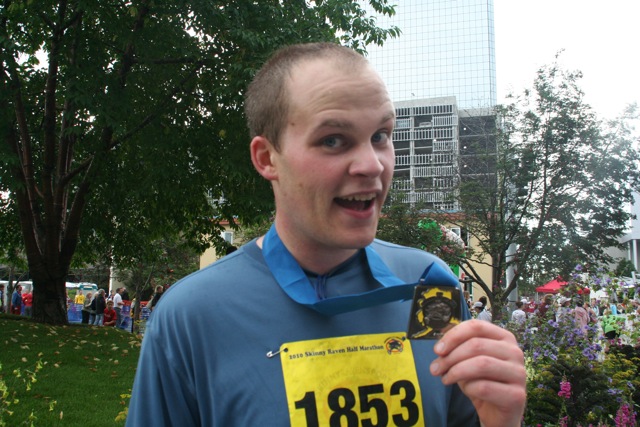
Brandon after his first half marathon in August 2010.
What’s one piece of advice you like to give?
If you’re interested in running, or just starting out, start slow. I think so many people get discouraged with running because in their heads, they want to just head out the door and run 5 miles on day one. If you’ve never run before, mostly likely you won’t be able to do that (without hurting yourself, anyways). I’d recommend using a program like Couch to 5k to help you get started, which is exactly what I did. It starts you out very slowly, with lots of walking breaks at first, and gradually builds you up to more and more running.
How has your healthier lifestyle impacted your family?
I like to think that it’s had a very large impact on my family. Whereas before, an evening after work commonly would have been spent in front of the TV, these days we’ll often go for a walk or a run together, usually with me pushing the jogging stroller with the kids. After seeing my success with it, my wife went through the Couch to 5k program too. She’s told me numerous times she has no interest in doing any sort of long distance running, but she gets out there for 30-40 minutes three times a week, which I think is great.
The biggest impact that I hope my healthier lifestyle has is on my two kids. They’re only 3 and 1 right now, but I hope that as they grow up in a house where eating healthy and being active is normal, that those things will rub off on them. My son already talks about wanting to run with me, and when we go out for walks as a family, the two of us always “race” home the last 100 feet or so. So I think it’s already starting to work.
What’s one non-running thing that people may be surprised to know about you?
I own two classic trucks. The first is a 1951 Ford that I restored with my dad. The story of why I chose “this” truck specifically to restore is kind of funny. If you remember the part in the movie “Forrest Gump,” when he’s being chased down an old country road by a truck full of teenagers, that’s this truck. While most people were watching and enjoying the movie, I was thinking “that’s a really cool looking truck, I want to own one of those some day.”
The second truck is a 1926 Model T that my grandfather restored. My grandfather has a bit of a retirement hobby of restoring classic cars, and has done five or six of them at this point. A few years ago, he was actually running out of room to store them, so he offered this one to me, which was the first that he had ever restored. It maxes out at around 25-30 mph, but it’s a heck of a lot of fun to drive, and you get a lot of friendly smiles and waves.
Keep up with Brandon on his blog, A Healthy Dad, as well as Twitter and Daily Mile. And don’t forget to check out his post today for a Q&A with me!
Recent Q&As and guest posts
* A Q&A with Dr. Wimmer, April 2011
* From baller to marathoner, January 2011
* A Q&A with Steena, October 2010
* A Q&A with Steve Spiers, June 2010
Recent Comments